
Software: Statistica Data Science Author (3-year license)
Statistica Data Science Author offers the full range of statistical methods, data import, export and preparation, visualisations and reporting, supplemented by machine learning and many other functions.
- Product: Statistica Data Science Author
- Version: Named User
- Language: English, Polish
- Number of users: 1
- License term: 3 years
- Delivery: electronic
We process deliveries subject to territorial restrictions.
Product code: 0EBC-7634A
Description
Statistica Data Science Author is an advanced environment for data analysis, statistical modeling, and machine learning that combines data preparation, a wide range of analytical methods, visualization, reporting, and process automation into a single solution.
The software offers a wide range of classical statistical methods as well as advanced analytical techniques and machine learning algorithms. It can be used both for quick ad hoc analyses and for building complex, repeatable analytical processes covering successive stages of data processing—from data collection and preparation, through modeling and evaluation of results, to reporting and utilization of the analysis results.

Advanced Statistical Analysis and Machine Learning
Statistica Data Science Author provides a comprehensive set of statistical methods, including descriptive statistics, correlation analysis, linear and nonlinear regression, ANOVA/MANOVA, nonparametric methods, multivariate analysis, factor analysis, cluster analysis, discriminant analysis, survival analysis, time series analysis, design of experiments (DOE), test power analysis, and interval estimation.
The solution also offers extensive capabilities in the field of machine learning. Available methods include, among others, artificial neural networks, support vector machines (SVM), k-nearest neighbors, classification and regression trees, CHAID, Random Forests, Boosted Trees, LASSO regression, MARSplines, Bayesian models, generalized additive models (GAM), and methods for selecting and evaluating predictors.
Additional tools include, among others, shopping basket analysis and association rules, relationship and sequence analysis, text mining, Weight of Evidence (WoE), optimal variable grouping, independent component analysis, model fit analysis, process optimization, and shelf life analysis.
Data Preparation, Profiling, and Cleaning
One of the key elements of analytical work is proper data preparation. Statistica Data Science Author offers tools that enable you to profile, clean, transform, and combine data before beginning the actual analysis.
Available functions include removing duplicates, recoding and ranking variables, merging data, handling outliers, imputing missing data, filtering, sampling, creating subsets, and selecting features and predictors.
The program also supports statistical transformations, including the Box-Cox transformation, which can be used to modify the distribution of variables before applying selected statistical methods and models.

Graphical Workspaces and Analysis Automation
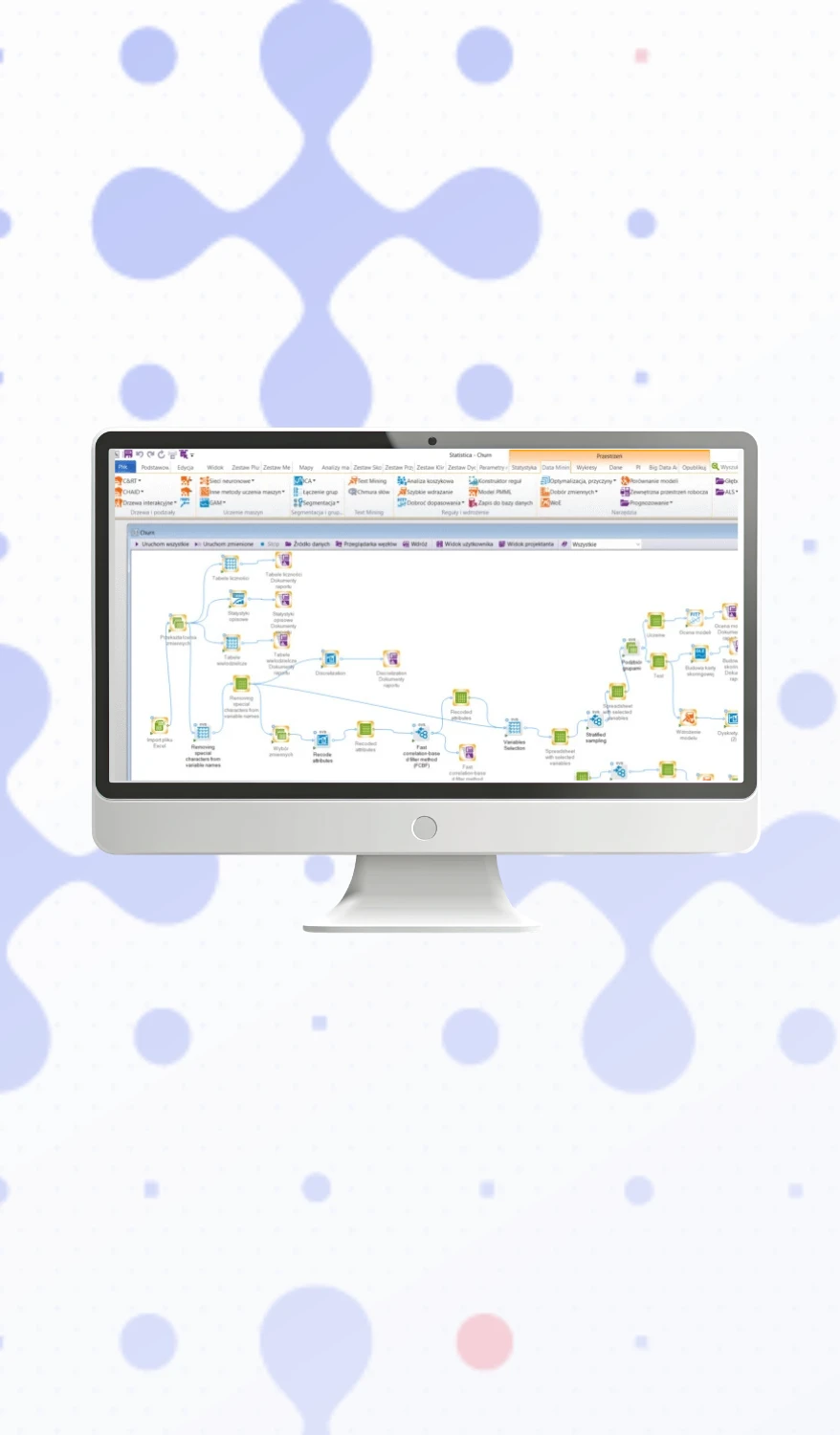
Analytical processes can be designed as graphical workflows within workspaces. These workspaces allow you to combine the successive stages of data extraction, data preparation, transformation, modeling, visualization, and reporting of results into a single process.
Workspaces can document individual stages of the analysis, making the entire process easier to track, rerun, and reuse for subsequent datasets. Created processes can be saved and reused multiple times, which promotes the standardization of analyses and reduces the need to manually repeat the same steps.
The environment supports both no-code and low-code approaches. Many processes can be created without programming, while more advanced users can extend them with their own code.
Workspaces can also call other workspaces, allowing for the creation of more complex and modular analytical processes.

Integration with R and Python
Statistica Data Science Author enables integration with popular languages used in data analysis and data science - R and Python. This allows you to use your own scripts, libraries, and custom computational methods as part of the graphical analytical process.
R and Python code can be part of a larger workspace and interact with other stages of data preparation, modeling, and reporting. This allows you to combine Statistica’s built-in functions with the flexibility of programming environments and leverage existing scripts and analytical libraries.
Data Import, Integration, and Export
Statistica Data Science Author allows you to work with data from multiple sources. It supports, among other things, importing data from Excel, CSV, and fixed-width text files. Data can also be retrieved from databases and then transformed, combined, and analyzed within the workspace.
You can create integrated datasets from various sources and use auxiliary data stored directly in the workspace, such as reference tables. Analysis results can be exported to Excel and CSV files, among others.

Visualization and Reporting
The solution offers a wide range of 2D and 3D visualizations to support data exploration and the interpretation of analysis results. Available options include histograms, line charts, scatter plots, mean plots with error bars, quantile-quantile plots, variability plots, contour plots, and probability plots.
Analysis results can be formatted and prepared for reporting, which facilitates their further use in documentation, presentations, and decision-making processes.
Analysis of Processes, Quality, and Product Shelf Life
Statistica Data Science Author also includes features designed for industrial, quality, and process applications. These include, among others, statistical process control (SPC), multidimensional statistical process control, control charts, process analysis, reliability analysis, and product shelf life analysis.
The solution can help identify process parameters that affect key quality characteristics, assess process stability, and determine optimal settings and conditions for process implementation.

Business Rules and Optimization
As part of more advanced analytical processes, a business rule builder is also available, which allows you to define rules used in analyses and decision-making processes.
Optimization features, on the other hand, allow you to analyze relationships between variables and search for parameter configurations that lead to the expected results. This can be used, for example, to optimize production processes, technological parameters, or model results.
Generating and Using Predictive Models
Statistica Data Science Author also allows you to prepare predictive models for use outside the analytical environment itself. It offers functions for generating model representations in various formats and languages, including C, C++, C#, Java, PMML, SAS, and SQL.
This makes it easier to transfer the prepared models to other systems and applications and to use the results of the analysis in operational processes.
Integration with the PI System
The solution also offers the ability to retrieve data from PI systems, which are used, among other things, to collect and share process data in real time. This allows data from industrial processes to be used directly in statistical analyses, predictive models, and optimization processes.
Statistica Data Science Author combines data preparation and integration, advanced statistics, machine learning, process automation, visualization, and reporting - as well as integration with R and Python - all within a single environment. Thanks to its graphical workspaces, the solution enables the creation of repeatable analytical processes—both without programming and using custom code for more advanced applications.
